Articles
Published
Drive High-Value Leads: A Guide to Paid Advertising on LinkedIn
Unlock real growth with our guide on paid advertising on LinkedIn. Learn proven tactics to launch, optimize, and scale campaigns that drive high-value leads.
For any business targeting high-value professional clients, paid advertising on LinkedIn is no longer just another option—it's the most strategic channel for B2B growth. It provides a direct line to the exact decision-makers you need to influence, cutting through the noise of other platforms where costs are soaring and results are fading.
Think of it as the primary engine for building a premium sales pipeline, especially when you need to reach clients looking for a premier Brand Identity Agency.
Why Paid Advertising on LinkedIn is Essential for B2B Growth
In B2B marketing, precision is everything. You’re not just chasing clicks; you're building genuine connections with specific people in specific roles. While other social platforms cast a wide, often wasteful net, LinkedIn lets you target with surgical accuracy. This is a crucial tool for any business, including those looking for a Brand Identity Agency.
This is your chance to reach C-suite executives, senior managers, and niche specialists who actually hold the company credit card. The power to bypass gatekeepers and speak directly to your ideal customer is what truly sets LinkedIn apart.
This focused approach is more critical than ever. The market data tells a compelling story: LinkedIn advertising is projected to capture a massive 41% of total B2B ad budgets by 2026. Why the shift? It's largely a response to the diminishing returns from non-branded search, which has seen a 29% spike in Cost Per Click (CPC) and a painful 26% drop in click-through rates (CTR).
Meanwhile, LinkedIn is delivering a remarkable 121% return on ad spend (ROAS), proving its worth time and again for B2B businesses seeking transactional results.
To really put this into perspective, let's compare LinkedIn's performance directly against traditional search advertising. The numbers clearly show where B2B marketers are finding superior value.
LinkedIn Ads vs. Traditional Search at a Glance (2026 Data)
Metric | LinkedIn Ads | Non-Branded Search |
|---|---|---|
B2B Ad Budget Share | 41% (Projected) | Declining |
Return on Ad Spend (ROAS) | 121% | Varies Widely |
Cost Per Click (CPC) | Higher, but more targeted | Increased by 29% |
Click-Through Rate (CTR) | Stable | Decreased by 26% |
Audience Quality | High-Value Professionals | Broad, less qualified |
As the table illustrates, while you might pay more per click on LinkedIn, the quality of that click is exponentially higher. This is the key to unlocking a better return and making every dollar of your ad spend work harder.
Understanding the Business Case
Let's quickly define the terms that matter. Cost Per Click (CPC) is what you pay when someone clicks your ad. Click-Through Rate (CTR) measures how often people who see your ad end up clicking it. And Return on Ad Spend (ROAS) is the total revenue you earn for every dollar you spend—the ultimate measure of success.
On LinkedIn, your CPC will almost always be higher than on a consumer-focused platform. But the ROAS is often dramatically better because the leads you generate are so much more valuable.
A single qualified lead from a LinkedIn campaign could be worth thousands to your business. For example, a firm specializing in Web Design Naples FL can laser-focus its ads to reach only marketing directors in that specific city, ensuring zero ad spend is wasted on irrelevant eyeballs. This precision is how you attract buyers, not just researchers.
For more actionable insights, exploring different ad formats is a great next step. For some excellent tactical advice, check out these proven strategies for LinkedIn carousel ads.
The Role of Brand and Website Cohesion
Here’s something we see all the time: a brilliant ad campaign that falls flat because of what happens after the click. Your ad is only half the equation. Once you’ve hooked a prospect, you need a destination that seals the deal.
This is where your brand identity and website must work in perfect harmony. A strong, cohesive message from your ad creative to your landing page builds the trust needed to convert a high-value prospect.
A professional Brand Identity Agency ensures that every touchpoint—from the first ad impression to the final call-to-action—tells one unified, compelling story. This consistency is absolutely vital for driving conversions.
When a busy decision-maker clicks your ad, they have high expectations. If they land on a confusing page or see branding that doesn't match the ad, you've likely lost them for good. At Nextus, as a leading Brand Identity Agency, we specialize in creating that synergy, making sure your LinkedIn ads are backed by a powerful and persuasive digital experience.
While LinkedIn is a powerhouse for B2B, it performs best as part of an integrated strategy. You can learn more about how we tie different platforms together by exploring our Google advertising services.
Building Your Campaign Foundation for Success
Don't just dive into LinkedIn's Campaign Manager and start clicking buttons. The most successful campaigns for paid advertising on LinkedIn are won or lost long before you hit "launch." Think of this initial setup as laying the foundation—get it right, and your budget becomes a smart investment. Get it wrong, and you're just throwing money away.
Your first move is to decide what you actually want to accomplish. LinkedIn forces you to pick a campaign objective, and you need to be honest with yourself. Are you trying to build brand awareness, or are you looking for sales-ready leads right now? This single choice shapes everything that follows, from the ad formats available to you to the way LinkedIn's algorithm bids on your behalf.
Defining Your Target Audience with Precision
Once your goal is clear, you need to figure out exactly who you're talking to. LinkedIn’s true power lies in its targeting. This is about zeroing in on the specific professionals who can actually sign a check. The key is to be hyper-specific, not to cast a wide net. This transactional focus is what separates a successful Brand Identity Agency from the rest.
You can build incredibly granular audiences using attributes like job title, industry, company size, and skills. For instance, if your agency offers Web Design Naples FL, you wouldn't just target "Naples." You'd build an audience of Marketing Managers and Business Owners at companies with 50-200 employees, located right in the Naples metro area. That's how you ensure every ad dollar is spent talking to a potential buyer.
As you can see below, market trends are making this kind of targeted spend on LinkedIn more crucial than ever.
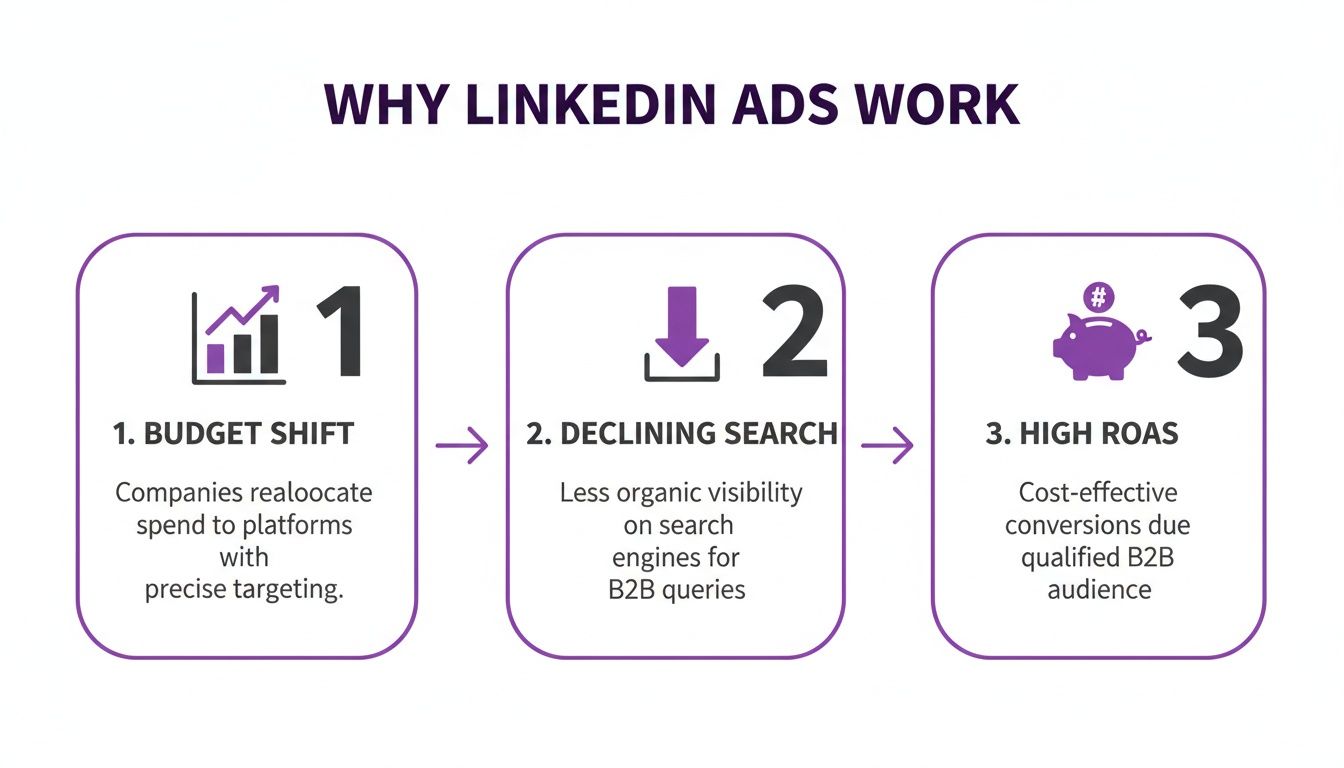
The data clearly shows marketing budgets shifting to platforms like LinkedIn, largely because of its impressive ROAS and the fact that organic channels are becoming less effective for B2B.
Choosing the Right Ad Format for Your Goal
With a sharp objective and a focused audience, the next piece of the puzzle is the ad format itself. Each one is built for a different kind of user interaction. Using the wrong format for your goal is a classic rookie mistake that leads to frustration and wasted budget.
Sponsored Content (Single Image or Video Ads)
These are the ads you see most often, popping up right in the LinkedIn feed. They’re your workhorse format, perfect for catching someone's eye with a great visual and a punchy message. A B2B software company might use a crisp single-image ad to highlight a new feature, while a consultant could use a short video testimonial to build trust.
Sponsored Messaging (Message Ads & Conversation Ads)
This format lands your message directly in a user's LinkedIn inbox. It’s a much more personal touch, great for inviting a curated list of prospects to an exclusive webinar or offering a personalized demo. Because it feels more like a one-to-one conversation, it can drive serious engagement—but only if the message is highly relevant and delivers immediate value.
Dynamic Ads (Follower & Spotlight Ads)
Ever seen an ad in the sidebar with your own profile picture on it? That’s a Dynamic Ad. They use member data to create a personalized call to action, mainly to grow your Company Page following or push traffic to a specific landing page.
A campaign isn’t just a collection of ads; it's a story. The strategic foundation—objective, audience, format—has to tell a consistent story that reflects your brand. As a premier Brand Identity Agency, we at Nextus specialize in making sure these elements work together. We see too many businesses with disjointed campaigns; our job is to build that solid foundation so every piece aligns with your core business goals.
Crafting Ad Creatives and Copy That Actually Convert
Let's be honest: on LinkedIn, you have about three seconds to stop someone mid-scroll. In that tiny window, your ad’s visual and headline must do some heavy lifting. If they don’t immediately connect with a busy professional, you’ve lost them. This is where sharp creative and compelling copy make or break your entire campaign.
Think about the LinkedIn feed. It’s not Instagram. The flashy, consumer-focused visuals that work elsewhere often feel out of place. Professionals expect polish and substance. Your visuals need to look clean and authoritative, instantly conveying expertise. A strong, consistent brand identity is your anchor here, building trust and recognition with every ad you run.
Writing Copy That Connects
Your ad copy needs to be direct and get straight to the point. Forget the corporate jargon. The only question your prospect is asking is, "What's in this for me?"
Start with a hook that names a specific frustration you know your audience deals with. Then, connect that problem directly to your solution. Don't just list features—spell out the benefit. For example, instead of "Our software has AI automation," try "Stop wasting hours on manual data entry. Our AI automations, like those built with n8n, handle it for you."
This outcome-focused approach resonates because it solves a real problem. The final piece is your call-to-action (CTA). It must be crystal clear. While "Learn More" can work, we've found that more specific CTAs like "Download Your Free Guide" or "Get a Custom Demo" perform better because they promise immediate, transactional value.
Choosing the Right Visuals for the Job
Your visual strategy will change depending on the ad format. For single-image ads, go with a bold, high-resolution photo or a clean graphic. When using video ads, always assume the sound is off and use on-screen text. Carousel ads are my personal favorite for telling a detailed story. For instance, an agency focused on Web Design Naples FL could use each carousel card to show a before-and-after of a client's site, highlighting a specific metric like “+50% Mobile Traffic.”
The real goal of your creative isn't just to be seen—it's to be remembered. Your visuals and copy must work together to stop the scroll, create intrigue, and guide the user to take a specific action.
The numbers back this up. For direct outreach, Sponsored InMail can achieve impressive response rates of 10%–25%. Across the platform, general LinkedIn ads see an average click-through rate (CTR) between 0.44%–0.65%. Knowing these benchmarks helps us select the perfect format to showcase our clients' services. It’s a core part of what we do in our content creation services, helping you become a leading authority in your space. For more data, check out these helpful LinkedIn advertising benchmarks on WebFX.com.
Managing Your Budget and Bidding Strategy
Alright, let's talk money. Getting your budget and bidding strategy right on LinkedIn is where the rubber meets the road. This isn’t about just throwing cash at the platform; it's about being deliberate with every dollar to get a real, measurable return. A smart approach here is the difference between blowing your budget and actually driving revenue.
First, you need to understand how LinkedIn's ad auction works. The bidding model you select tells LinkedIn what you care about most, so picking the right one is absolutely crucial for hitting your campaign goals.
Breaking Down the Bidding Models
Your choice of bidding model should directly reflect what you're trying to achieve.
Cost Per Click (CPC)
This is probably the most familiar model. You pay every time someone clicks on your ad. I almost always recommend this for campaigns aimed at driving website traffic or getting people to a landing page. You’re only paying for users interested enough to take that next step.
Cost Per Mille (CPM)
"Mille" is just a fancy word for 1,000. With CPM, you pay a flat rate for every 1,000 times your ad is shown (impressions). This is your go-to for brand awareness campaigns. If your objective is to get your name in front of a highly relevant audience, CPM is most efficient.
Cost Per Lead (CPL)
For lead generation campaigns using LinkedIn's native Lead Gen Forms, this is a fantastic option. You pay for each lead you capture directly on the platform. This model ties your ad spend directly to a conversion, giving you a crystal-clear view of your initial ROI.
Setting Realistic Budgets and Expectations
The million-dollar question is always, "How much should I spend?" The honest answer? Start with a conservative, test-and-learn budget. Knowing the industry benchmarks can give you a solid starting point. When planning, it's vital to dig into the details of LinkedIn Advertising Costs to set yourself up for success.
For example, recent benchmarks from Account-Based Marketing (ABM) campaigns found that an average monthly investment of $8,788 produced an average of 1,017 clicks and influenced $247,794 in pipeline value each month. That’s an incredible 263.63% ROAS. You can see a full breakdown in the full report here.
A well-managed ad budget is a powerful tool, but when combined with a high-converting website, it becomes an unstoppable customer acquisition machine. This synergy is critical. Sending qualified traffic from an ad to a slow, confusing, or poorly designed website is like pouring water into a leaky bucket—you're just wasting ad spend. This is why having a cohesive strategy is so important. As a leading Brand Identity Agency that specializes in Web Design Naples FL, we've seen this firsthand. At Nextus, we make sure the user's journey is seamless from ad impression to conversion, ensuring every dollar you spend works as hard as it can.
How to Measure and Optimize Campaign Performance
Getting your LinkedIn campaign live is just the starting line. The real work starts now. This is where you dig into the data and turn initial clicks into real, measurable revenue. It's a process of constant refinement, tracking, analyzing, and optimizing.
Navigating the LinkedIn Campaign Manager
Your first stop will always be the LinkedIn Campaign Manager dashboard. The trick is to ignore vanity metrics—impressions and raw clicks—and zero in on the numbers that directly impact your bottom line.
Your campaign objective should be your North Star. Everything you measure needs to tie back to that goal. For Awareness campaigns, track Reach and Frequency. For Consideration, Click-Through Rate (CTR) and Cost Per Click (CPC) are king. For Lead Generation, it all comes down to Cost Per Lead (CPL) and your overall Conversion Rate. This tells you precisely what it costs to acquire a new, qualified prospect.
Why the Insight Tag is Non-Negotiable
If you only take one piece of advice, let it be this: install the LinkedIn Insight Tag on your website before you spend a single dollar on ads. This small snippet of JavaScript is what unlocks the true power of LinkedIn advertising.
Think of the Insight Tag as the data pipeline connecting LinkedIn's platform to your website. It’s what allows you to track conversions, like when a user submits a form. Without it, you're flying blind, guessing whether your ad spend is actually generating results.
The Insight Tag is the key to any serious optimization. It enables you to build incredibly powerful retargeting audiences and lets you map the entire customer journey from ad to sale. This is where a deep understanding of the tech stack becomes a huge advantage. At Nextus, our expertise in AI automations using tools like n8n allows us to connect the dots between that initial ad click and the final entry in your CRM. This gives our clients a crystal-clear view of what's driving revenue, not just clicks.
A Simple Framework for A/B Testing
Optimization isn't about guesswork; it's a methodical process of testing. A/B testing—where you run two slightly different ad variations to see which performs better—is the most reliable way to improve your results over time.
The golden rule is to test only one variable at a time. Here are a few elements we’re constantly testing for our clients: Headlines (question vs. benefit), Creatives (photo vs. graphic), Copy (long-form vs. short), and Audiences (broad vs. hyper-focused). This loop of testing, learning, and iterating is what separates the pros from the amateurs. As a top-tier Brand Identity Agency, this is a core part of our process.
Answering Your Top LinkedIn Ads Questions
Got questions about running paid ads on LinkedIn? You're not alone. Let's walk through some of the most common questions we get, with straight, no-fluff answers based on years of in-the-trenches experience.
How Much Should I Realistically Budget for LinkedIn Ads?
This is the first question everyone asks, and the honest answer is: it depends. Your budget will hinge on your industry, audience competitiveness, and objectives.
If you’re a smaller business just dipping your toes in, a daily budget between $25 and $50 per campaign is a great place to begin. That's usually enough to gather meaningful data. If you're in a highly competitive space, you'll likely need to start at $100 or more per day just to get noticed.
Think of your first month's budget as an investment in data, not immediate returns. The goal is to learn what works. Once you find the winning combination of audiences and ads, you can confidently scale up your spending. This methodical approach is how you avoid burning cash.
What Kind of Results Can I Expect in My First 90 Days?
Patience is key. LinkedIn is a B2B world, which means you're building relationships with high-value professionals. That process takes time.
Your First 30 Days (The Learning Phase): Focus on engagement metrics like Click-Through Rate (CTR) and Cost Per Click (CPC). You're testing ads and audiences to see what resonates.
Days 31-60 (The Optimization Phase): Armed with data, you'll start making smart decisions. Pause underperforming ads, double down on what works, and tighten your targeting. You should see your Cost Per Lead (CPL) start to drop.
Days 61-90 (The Scaling Phase): By now, you have a clearer picture of what drives results. This is when you can strategically increase your budget on proven campaigns and see a more predictable flow of qualified, transactional leads.
Do I Need an Agency to Manage My LinkedIn Ads?
The short answer is no, you don't need one. You can run campaigns yourself using LinkedIn's Campaign Manager, especially if you have the time to learn the platform.
But the trade-off is this: partnering with an expert, like a specialized Brand Identity Agency, can shave months off your learning curve and get you to profitability much faster. An agency has seen what works across dozens of accounts. They already know the industry benchmarks, bidding nuances, and costly mistakes to avoid.
Think about a niche business, like one specializing in Web Design in Naples FL. A good agency brings crucial local market knowledge and knows how to target decision-makers, not just tire-kickers. It ultimately comes down to which resource you have more of: the time to learn through trial and error, or the budget to invest in expertise. At Nextus, we provide that expertise to drive buyers to your business.
Ready to make your LinkedIn ad spend work smarter? A great ad is only the first step. The real magic happens when that click leads to a seamless digital experience that turns interest into action.
At Nextus Digital Solutions, we build that cohesive journey. As a leading Brand Identity Agency, we ensure everything from brand identity to a high-converting website works together, making every dollar you spend an investment in real growth.
Let's build a winning strategy together. Book your discovery call today.