Articles
Published
Brand Identity Agency: How to Create a Strategy That Drives Buyers
How to create a brand strategy - Unlock success! Learn how to create a brand strategy that deeply resonates with your audience. Master proven techniques for bui
Think of brand strategy as the master plan for shaping how buyers feel about your business. It's the blueprint that defines your purpose, clarifies your values, and connects with your target audience in a way that guides every single interaction. When you hire a professional Brand Identity Agency, the goal is to ensure all your marketing, design, and business decisions are pulling in the same direction to drive transactional results.
Laying the Foundation: Why Strategy Always Comes First
Before sketching logos or brainstorming taglines, you need to pour the foundation. A solid brand strategy is the core plan that governs how your audience sees you, making sure every move you make supports your biggest business goals. This isn't just a creative task; it's a direct line to growth and customer loyalty, turning researchers into buyers.
This has become even more critical as business gets more efficient—and often, more impersonal—with AI automations from tools like n8n. In a market flooded with automated interactions, people are searching for genuine connection. Your brand is how you build it.
The numbers don't lie. The combined value of the world’s 5,000 biggest corporate brands is projected to climb from USD 13.2 trillion in 2024 to over USD 14 trillion in 2025. This isn't just a big-business game; it shows that a strong brand is a powerful economic engine, a crucial insight for any startup or small business aiming to attract high-intent customers.
Strategy Before Style
Jumping straight into design without a strategy is like building a house without a blueprint. It might look good for a moment, but it's not built to last. Your strategy is the "why" that holds everything up.
To create an actionable strategy, you must answer these questions first:
What is our core purpose?
What problem do we exist to solve for a specific buyer?
What values guide every decision we make?
Answering these questions is what allows a business, whether it's a local service provider or an e-commerce startup, to carve out its space and build real value. It can feel like a lot to tackle, which is why many businesses partner with a specialized Brand Identity Agency like Nextus. We provide the expert guidance needed to nail these early, critical steps and position you for transactional success.
This visual shows how a clear purpose, authentic actions, and sustainable growth all lock together to form a powerful foundation.
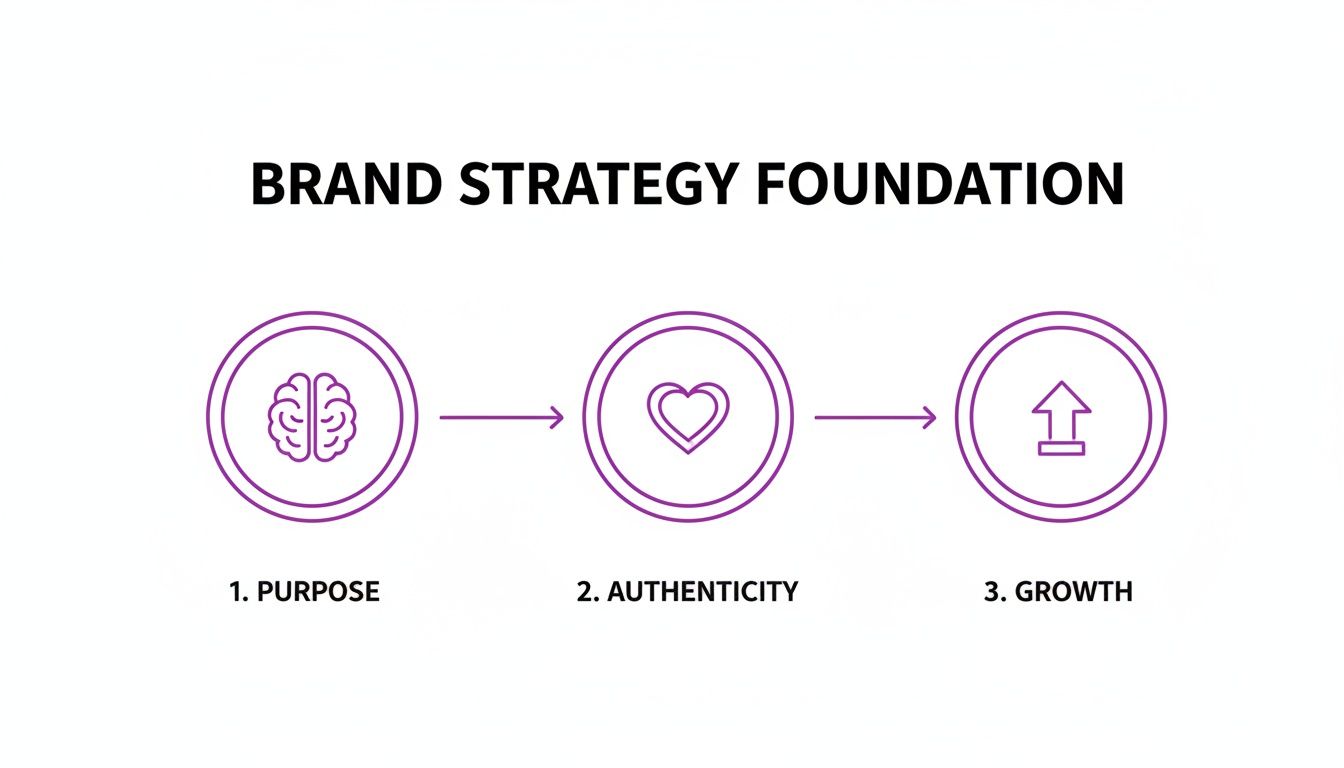
You can see how a clear purpose leads to authentic actions, which is what ultimately drives real business growth. Each element depends on the others.
It All Starts With Your Audience
You can’t build a brand for everyone. The first and most critical step in laying your foundation is to identify your target audience with absolute clarity. You simply can't connect with people you don't truly understand. Your entire strategy must be built around their needs, their frustrations, and what they hope to achieve.
A brand strategy isn't about what you want to say; it's about what your audience needs to hear. It shifts the focus from "our product is great" to "here's how we make your life better."
This mindset forces you to be customer-obsessed from day one. It shapes your messaging, your visual identity, and even the platforms you choose to show up on. This focus is a central pillar of effective local business marketing strategies that build deep community roots and drive local sales.
When you know exactly who you're talking to, every other decision becomes simpler and more effective. That’s how you transform your business from just another option into the only choice for your ideal buyer. It's not just theory—it's the bedrock of a brand that wins hearts, minds, and market share.
Defining Your Brand’s Core Identity

Now let's define the soul of your business. This isn't about crafting corporate-sounding statements for your website. It's a deep-dive discovery process to uncover what makes your business tick. This is the foundation for every marketing campaign, design choice, and sales pitch you'll ever make.
This is the part of the process where a professional Brand Identity Agency really earns its keep. At Nextus, we spend most of our time right here, because when you nail your core identity, every other piece of the puzzle just falls into place.
Articulating Your Brand's Purpose and Mission
Your brand’s purpose is your "why"—the reason you exist beyond just making a profit. Your mission, on the other hand, is the "how"—your actionable plan for bringing that purpose to life. To define them, you've got to ask tough questions and be brutally honest with your answers.
Start with this one: What problem do we solve better than anyone else?
Don't just list services. Think about the real transformation you offer. A plumber doesn't just "fix pipes"; they "restore peace of mind for homeowners during a crisis." That’s a purpose. Your mission is the clear, direct statement of what you do, who you help, and the value you deliver.
A strong brand purpose answers the question, "Why should anyone care?" It's the emotional hook that turns a one-time customer into a loyal advocate for life.
This clarity is absolutely essential when you're figuring out how to create a brand strategy that actually works. For a small business in a crowded market, your purpose and mission are often your single greatest advantages. It's the core message that should inform everything, from your social media posts to a strategic Web Design Naples FL project, ensuring your digital presence is a true reflection of who you are.
Uncovering Your Core Values
Think of core values as the rules of the house. They’re the non-negotiable beliefs that guide how your company acts, especially when no one is looking. They have to be real to mean anything.
To find yours, get your team together and ask: What principles guide our decisions when things get tough? Look back at past challenges. The way you handled them reveals what you truly value. You're looking for 3-5 specific, actionable values.
Forget generic fluff like "Integrity." Instead, try something with teeth, like "We Do the Right Thing, Even When It's Hard." That gives your team a clear compass and shows customers you mean what you say. It’s that kind of authenticity that builds trust and gets people to buy.
Defining Your Ideal Customer Beyond Demographics
Knowing your customer's age and location is just scratching the surface. To build a brand that people genuinely connect with, you have to understand their psychographics—their worries, their ambitions, and what they truly value. This is where you move beyond data points and start building a persona that feels like a real human being. Psychographics is a marketing term for the study of consumers' attitudes, aspirations, and other psychological criteria.
A great exercise is to imagine your perfect customer. Give them a name and a backstory. What keeps them up at night? What are they trying to accomplish? A small business owner in Naples isn't just looking for a website; their real pain point might be feeling invisible and struggling to stand out from the competition.
Once you have that vivid picture, every part of your brand strategy can be designed to speak directly to them. At Nextus, this deep dive is central to our process. By moving past shallow data, we help you build a brand that resonates on a human level—and that’s what attracts committed buyers, not just casual researchers.
With a clearer sense of your own brand’s core, the next step is to size up the competition. No brand operates in isolation; you’re constantly fighting for a unique spot in your customer's mind. This means getting into the weeds and analyzing your competitors to see what they do well and, more importantly, where they’re dropping the ball.
This isn't just an academic exercise. A solid competitor analysis is foundational to learning how to create a brand strategy that actually works. It’s all about spotting the gaps in the market—the unmet needs, the clunky customer experiences, the missed opportunities. These gaps are exactly where you can build a brand that people notice and choose.

Identifying Your True Competitors
First, you need to think bigger than just the obvious players. Your competition falls into two camps: direct and indirect. Direct competitors offer a nearly identical solution to the same crowd. Indirect competitors, on the other hand, solve the same core problem with a different product or service.
For example, a custom home builder’s direct competitor is the builder down the street. But an indirect competitor? That could be a high-end renovation company persuading homeowners to upgrade their current place instead of building a new one. Understanding both is crucial because it gives you a complete view of the forces influencing your customers.
To get started, make a simple list. Fire up a search engine and use transactional keywords a real customer would, like "hire [your service] in [your city]," and see who pops up on the first page. This simple SEO search is a surprisingly powerful first move in gathering competitive intel.
Think of competitor analysis as searching for your unique "doorway" into the market. By seeing which doors are wide open and which are locked tight, you can find your own path to connect with customers.
This is especially true in crowded local markets. For one of our Web Design Naples FL clients, success meant we first had to map out the visual styles and marketing claims of every local agency. Only then could we craft a brand that wouldn't just get lost in the noise but actively attract buyers.
Dissecting Their Strategies
Once your list of competitors is ready, it's time to put on your detective hat. For each one, walk through their entire marketing and sales process from a customer's perspective. Follow them from a social media ad or Google search, through their website, and all the way to their checkout or contact process.
Zoom in on these key areas:
Brand Messaging and Tone: What are the main messages they hammer home? Is their voice strictly professional, super casual, or maybe inspirational?
Visual Identity: Take a hard look at their logo, color scheme, and the photos they use. Does it feel current and credible, or does it look dated?
Market Positioning: How are they framing themselves? Are they the "cheap and cheerful" option, the "premium luxury" choice, or the "go-to expert"?
Customer Reviews: This is where you find the gold. Comb through reviews on Google, Yelp, and other industry-specific platforms. Look for patterns in the complaints—that’s your roadmap for what to do better.
This deep-dive analysis is often where bringing in a professional Brand Identity Agency can make a huge difference. Agencies like Nextus use sophisticated SEO and market research tools to create a data-driven map of the competitive terrain, uncovering opportunities you might have missed on your own.
At the end of this process, you’ll not only understand the established "rules" of your market, but you’ll also have a concrete list of ways to break them. This is how you find your own space—a space that's distinct, authentic, and profitable.
DIY vs Agency Brand Strategy Development
Deciding whether to build your brand strategy in-house or hire a professional is a major crossroads for any business. The DIY route offers control and saves on upfront costs, but it demands a significant investment of your time and a steep learning curve. Partnering with an agency brings expert guidance and market-tested processes, but requires a financial investment.
This table breaks down the key differences to help you decide which path is right for you.
Aspect | DIY Approach | Hiring an Agency (e.g., Nextus) |
|---|---|---|
Expertise & Experience | Relies on internal knowledge and online resources. Risk of overlooking market nuances. | Access to a team of specialists with deep industry experience and proven methodologies. |
Time Investment | Extremely high. Key team members must dedicate significant time away from core business functions. | Minimal. The agency handles the heavy lifting, from research to execution, freeing you up to run your business. |
Tools & Resources | Limited to free or low-cost tools, potentially missing out on deeper data and insights. | Utilizes professional-grade tools for SEO, market research, and competitive analysis (e.g., Ahrefs, Semrush). |
Objectivity | Can be challenging. It's difficult to see your own brand's weaknesses and biases. | Provides an objective, outside perspective to identify blind spots and challenge assumptions. |
Cost | Lower upfront financial cost, but high opportunity cost in terms of time and potential mistakes. | Higher initial investment, but aims for a greater ROI through a more effective, faster launch. |
Speed to Market | Slower process due to the learning curve and competing internal priorities. | Faster execution. Agencies have streamlined processes designed to deliver a complete strategy efficiently. |
Ultimately, the choice comes down to your company's resources, timeline, and internal expertise. A well-executed DIY strategy can certainly work, but an agency partnership is designed to accelerate your growth and mitigate the risks of a flawed or incomplete brand foundation.
Crafting Your Brand Positioning and Messaging
Now for the fun part. You’ve done the hard work of digging into your market and defining who you are. It’s time to take all that research and give it a voice—the words that will actually reach out and connect with your customers. This is where you stake your claim in the market.
This isn’t just about writing catchy copy. It’s about building a solid messaging framework that makes every email, ad, and social media post work for you. Getting this right is what separates brands that build trust and drive sales from those that just make noise. It’s a core reason companies hire a dedicated Brand Identity Agency; we specialize in turning those strategic insights into language that sells.
Developing Your Brand Positioning Statement
First, you need an internal North Star. That's your brand positioning statement. It’s a tight, focused sentence that spells out exactly where you fit in the market, who you serve, and why you’re the only real choice for them. This isn't meant for your customers to see—it’s for you and your team to keep everyone rowing in the same direction.
A simple formula I’ve used for years gets the job done perfectly:
For [Target Customer] who [Need/Problem], our [Brand] is the [Category] that provides [Benefit/Promise] because only [Brand] can [Unique Differentiator/Reason to Believe].
Let’s make it real. For a local plumbing business, it might be: "For Naples homeowners who need reliable emergency plumbing, our company is the service provider that delivers immediate peace of mind because only we guarantee a 60-minute response time and a 5-year workmanship warranty." See? It’s not a flashy tagline. It’s a strategic anchor.
Your positioning statement is the bridge between your grand strategy and your day-to-day marketing. It’s the test you run every piece of content against before it goes out the door.
This single statement gives you the clarity you need to build out all your other messaging. It's a fundamental part of learning how to create a brand strategy that doesn't just look good on paper but actually brings in the right customers.
Building Your Messaging Framework
With your positioning locked in, you can start building the language your customers will actually hear and read. This usually breaks down into a tagline, a value proposition, and a few key communication pillars.
Your tagline is that short, memorable hook that sums up your brand’s promise (think Nike's "Just Do It"). Your value proposition goes a step further, clearly stating the tangible benefits someone gets by choosing you over a competitor.
From there, you’ll want to define your communication pillars. These are the three to four core themes you'll hit on again and again. For a Web Design Naples FL agency like ours, those pillars might look like this:
Strategic Growth: We don’t just build digital brochures; we build powerful business tools that drive revenue.
Bespoke Design: Your brand is one-of-a-kind, and your website should be too. No templates, ever.
Transparent Partnership: You’re never in the dark. We keep you involved and informed at every single stage.
These pillars then become the foundation for everything from your blog posts to your sales pitches.
Defining Your Brand Voice and Tone
Finally, you have to decide how you say things. Your brand voice is its personality—are you an undisputed authority, a witty sidekick, a warm empath, or a high-energy motivator? This voice needs to be consistent, always.
Your tone, on the other hand, should change with the context. I like to explain it this way: you have one personality (your voice), but you speak differently to your best friend than you do to a new client (your tone). So, your brand might sound encouraging in a welcome email but needs to be direct and reassuring on a 404 error page.
This consistency is everything. People expect more from brands today; the "brand as citizen" idea is becoming a reality. A modern brand strategy has to weave purpose and values into every message, turning promises into real actions that build deep trust. For trades and small businesses, that emotional connection is a massive driver for both leads and long-term loyalty. You can discover more about branding trends for 2026 to see just how important this is becoming.
At Nextus, a huge part of our job is making sure this cohesive story is told at every touchpoint, from the copy on your homepage to the automated emails you send out. It’s that obsessive attention to detail that turns a simple service provider into a brand people remember and trust.
Bringing Your Brand to Life: Visuals and Digital Footprint
You've done the hard work of defining your brand's core message and strategy. Now for the exciting part—translating those ideas into the sights and sounds that will define your business. This is where abstract concepts like your company values become tangible assets like your logo, colors, and the overall feel of your website.
Think of it as giving your brand a face and a voice. It’s about building a consistent visual language that tells your story in a heartbeat, whether someone sees your van on the road, scrolls past your ad on Instagram, or lands on your homepage.
From Strategy to a Visual Language
A brand's visual identity is its uniform. It instantly signals who you are and what it’s like to do business with you. A strong, cohesive system ensures you look and feel the same everywhere, building recognition and trust with every interaction.
For example, a high-end contracting business might use a strong, monochromatic color scheme with a bold, geometric logo to communicate precision, reliability, and expertise. On the other hand, a local, family-owned bakery might opt for warm, earthy tones and a hand-drawn font to evoke a sense of comfort and tradition. These choices aren't accidental; they're the direct result of a well-thought-out brand strategy from an expert Brand Identity Agency.
The Psychology Behind Your Visuals
Every visual element you choose sends a subconscious message. Getting these right is a fundamental part of building a brand that truly connects with people on an emotional level.
Here’s a look at the core components you’ll need to define:
Logo: This is your brand's signature. Is it sharp and modern, suggesting efficiency and cutting-edge work? Or is it softer and more organic, hinting at a personal, human touch? Your logo is often the first visual handshake.
Color Palette: Colors come with powerful, built-in associations. Blues and grays often signal trust and professionalism (think finance or tech), while vibrant yellows and oranges can convey energy and optimism. A smart color palette doesn’t just look nice; it makes your customers feel something specific.
Typography: The fonts you use say a lot. A classic serif font like Times New Roman can feel traditional and authoritative, while a clean, sans-serif font like Helvetica or Montserrat feels much more modern and approachable.
Imagery: Your photos and videos are a window into your brand’s world. Do you use polished, professional headshots and stock photos, or do you feature candid, behind-the-scenes shots of your team in action? The right imagery helps your audience see themselves as part of your story.
These elements combine to create an immediate gut feeling about your business. You can dive deeper into how visual trends are evolving by checking out the full research about 2026 branding trends.
Your Website: The Heart of Your Digital Brand
Your website is the ultimate expression of your brand strategy. It’s the one place online that you completely own, and it's where your messaging, visuals, and business goals must come together seamlessly. A strategic website isn't just about looking good; it's about creating an experience that guides visitors and turns them into customers.
A great website is a brand’s hardest-working employee. It should be attracting qualified leads, telling your story, and building trust, 24/7.
This means every part of your site should reinforce your brand. For example, if a core brand pillar is "Effortless Customer Service," your website must have an easy-to-find phone number, a simple contact form, and maybe even a live chat feature. SEO is also woven directly into this fabric, ensuring the right customers can find you when they search for the problems you solve.
We take this a step further by integrating marketing automation tools like n8n directly into the websites we build. This allows us to create automated, personalized customer journeys that feel incredibly helpful, reinforcing a brand's promise of being efficient and customer-focused. To see how we translate strategy into a powerful digital presence, you can explore our brand design services. The goal is a website that not only looks incredible but also works tirelessly to grow your business.
Bringing Your Brand Strategy to Life
All the research and planning in the world won’t matter if your brand strategy just sits in a folder. This is where the rubber meets the road—the moment your blueprint becomes a living, breathing part of your business. It's about taking that hard-earned clarity on your messaging and identity and infusing it into every single place a customer might find you.
Without a thoughtful rollout, even the most brilliant strategies sputter out, leaving customers with a confusing and inconsistent picture of who you are. The real goal is to make your brand feel the same everywhere. Whether someone sees a social media post, opens an invoice, or talks to a customer service rep, the impression should be cohesive. That's how you build recognition and genuine trust.
Build Your Internal Brand Playbook
You can't be everywhere at once, which is why your first move is to empower your team. The best way to do this is with a central source of truth: your brand guidelines. Think of it less as a restrictive rulebook and more as a playbook that gets everyone—from marketing to sales to new hires—on the same page.
This guide needs to be practical. It should clearly spell out:
Visual Rules: How to use the logo (and how not to), the official color palette with HEX codes, and the correct fonts for headlines and body text.
Messaging & Voice: Your brand positioning statement, core message pillars, and real examples of your brand voice in action.
Practical Examples: Showcasing "do's and don'ts" for common situations like writing an email signature or a social media caption.
This playbook is what allows a business to grow without losing its soul. Any professional Brand Identity Agency will tell you these guidelines are a non-negotiable deliverable, because they’re essential for keeping the brand strong over the long haul.
Activate Your Brand Across Every Channel
With your guidelines in hand, you're ready to launch. You’ll want to be strategic here, hitting the highest-impact channels first. For most businesses, the website is the perfect place to start, since it’s the central hub for your entire digital presence.
From there, conduct an audit and update all your other brand assets. This includes:
Social media profiles (banners, bios, and post templates).
Email marketing templates and automated sequences.
Sales collateral like presentations and proposals.
Customer service scripts and email signatures.
A huge piece of the puzzle is having a strategic content plan for user acquisition. This ensures that the message you're putting out there doesn't just sound like your brand, but actively works to bring in your ideal customers.
Execution is the art of showing up consistently. It’s proving to your audience, through every small action, that you are exactly who you say you are. This turns a brand promise into a brand reality.
At Nextus, we help our clients not only craft their strategy but also put it into action. This means developing the right messaging and visuals and exploring how our content creation services can fuel your launch with assets that truly connect and convert. Real activation is about making your brand an undeniable and valuable presence in your market.
Your Brand Strategy Questions Answered
Diving into a brand strategy project always brings up a few big questions. That's a good thing—it means you're thinking critically about the process. We get these all the time from business owners, so let’s get you some straight answers so you can move forward with confidence.
How Much Does It Cost to Hire a Brand Identity Agency?
This is usually the first question on every founder's mind, and the honest answer is: it depends entirely on the scope. There's no single price tag.
Think of it this way. A startup just getting its footing might need a foundational identity package—a solid logo, a defined color palette, and some basic brand guidelines. That kind of project might start in the low thousands. On the other hand, an established business looking for a complete overhaul needs much more. That means deep market research, a full messaging and positioning framework, and tons of design work, so the investment will be significantly larger.
At Nextus, we build our proposals around your specific goals. It's not about forcing you into a box; it's about matching the investment to the growth and value you’re aiming for.
What Is a Typical Timeline for a New Brand Strategy?
Building a brand is a marathon, not a sprint. While everyone wants to move fast, a realistic timeline can be anywhere from 4 weeks to 6 months. The timeline is dictated by the complexity of the project.
A rushed brand strategy often misses the mark. The timeline isn't just about deliverables; it's about allowing time for deep thinking, creative exploration, and gathering meaningful feedback.
Here's how it generally breaks down from our experience:
Discovery & Research: This initial deep dive usually takes 1-2 weeks.
Strategy & Messaging: Nailing down your core message and position can take another 2-4 weeks.
Design & Development: The visual identity and a full website build, like a comprehensive Web Design Naples FL project, can easily take an additional 4-8 weeks or more before you're ready to launch.
What Are the Biggest Mistakes to Avoid in Brand Strategy?
We've seen a few common missteps that can derail a brand strategy before it even gets going.
The biggest mistake is designing for yourself instead of your customer. It’s so easy to let personal taste get in the way of what the market data is telling you.
Another classic error is inconsistency. When your social media posts say one thing, but your customer service experience says another, you break trust. Finally, a surprising number of businesses build their brand on assumptions. They skip the research and end up with a brand that doesn't connect with their audience or stand out from their competitors.
Ready to avoid these mistakes and build a brand that truly connects? The team at Nextus Digital Solutions is the Brand Identity Agency that specializes in turning strategic insights into powerful brand identities and high-converting websites that drive real growth.