Articles
Published
Google Ads Management in Naples, FL: Why Your Budget is Being Wasted (And How We Fix It)
Stop wasting your Google Ads budget. Discover why Naples agencies fail and how senior-level strategy, clean tracking, and AI SEO integration drive real ROI.

You feel it every time you open your monthly report.
The charts look polished. The click numbers sound busy. The agency presentation has enough acronyms to make it feel expensive. There’s always a graph going up, always a new “optimization,” always some vague reassurance that the algorithm is “learning.”
And yet? Your bank account is not impressed.
If you’re paying for Google Ads management in Naples, FL, and all you’re getting back is a pretty dashboard, a vague monthly call, and a handful of low-intent leads who ghost you after asking one question, your budget probably isn’t being “optimized.”
It’s being bled out slowly.
That may sound blunt, but let’s be honest: a lot of local agencies have gotten very comfortable selling “management” when what they really offer is glorified platform babysitting. They set up a campaign, skim the search terms once in a while, turn on Google’s auto-recommendations, outsource the real work to cheap freelancers, and call it strategy. That might work if you’re selling novelty mugs online. It does not work in a premium market like Naples, where one wasted click can be the start of a very expensive pattern.
At Nextus Digital Solutions, we take a different view. We don’t treat paid search like a slot machine. We treat it like an engineered revenue system. That means tighter keyword strategy, stronger offer positioning, better landing pages, real conversion tracking, cleaner creative, faster pages, and proper integration with the rest of your digital ecosystem including Web Design, AI SEO, Content Creation, and AI Automation.
Because here’s the uncomfortable truth:
> Golden Nugget: If your Google Ads strategy is not connected to your website speed, your CRM, your sales pipeline, and your organic search strategy, you do not have a growth engine. You have a leak with a login.
This guide is built to help you see the difference.
We’re going to break down why so many Naples business owners are paying what amounts to an agency tax, how to spot the middlemen, why vanity metrics are the oldest con in the local marketing playbook, why “set and forget” management quietly burns cash, why technical precision matters more than clever ad copy, how Quality Score and landing page experience quietly shape your CPCs, and what a real senior-level growth system looks like when it’s designed to produce profit instead of PowerPoints.
If you’ve been overwhelmed, annoyed, or quietly suspicious that your current setup isn’t pulling its weight, good. That instinct is probably right.
Let’s cut through the noise.
Why So Many Naples Businesses Waste Money on Google Ads
Naples is not an average market, and that is exactly why average campaign management fails here.
You are not advertising into a generic pool of buyers. You are competing in a market with high-income zip codes, selective consumers, premium service expectations, elevated click costs, and industries where a single closed lead can be worth thousands or tens of thousands of dollars. That creates a dangerous equation: high click costs + lazy execution = very expensive mediocrity.
A lot of agencies know they can get away with this because most business owners are busy. You’re running operations, managing staff, handling clients, and trying not to spend your Friday morning deciphering why your campaign matched for “free” searches, student searches, job searches, DIY intent, or people clearly looking for something else entirely.
So the agency leans on the oldest trick in the book: report activity, not outcomes.
You get:
Impressions
Clicks
CTR
“Traffic growth”
A few screenshots from Google Ads
A color-coded chart
Zero clarity on revenue
That’s not strategy. That’s decorative reporting.
The numbers don’t lie. But agencies often tell the wrong story with them.
A healthy Google Ads account should answer questions like:
Which campaigns generate qualified leads?
Which keywords produce booked calls, form submissions, and actual sales?
Which landing pages convert best by service and location?
Which zip codes create profitable demand versus curiosity clicks?
What is your true cost per acquisition?
What happens after the lead enters your pipeline?
Which campaigns deserve more budget, and which deserve a mercy killing?
If your current agency cannot answer those questions cleanly, they are not managing your business. They are managing your ad spend.
Here’s the deeper technical issue: Google Ads optimization is only as smart as the signals you feed it. If your agency tracks shallow actions, optimizes to junk leads, or ignores CRM outcomes, the platform will dutifully get you more of the wrong thing. The algorithm is not a wizard. It is an amplifier. Bad input becomes expensive output.
That matters in Naples because the market doesn’t forgive sloppy signal quality. When CPCs are high and buyer expectations are even higher, every mismatch between keyword, ad, landing page, and follow-up process compounds into wasted spend. That is why mediocre management does not just underperform here. It actively gets more expensive over time.
Strategic Anchor: Paid search only becomes valuable when it is tied to buyer behavior and business outcomes, not surface-level platform activity.
The Naples Agency Tax: Why Local High Overhead Is Killing Your ROI
Let’s get provocative for a second.
There is a version of the “Naples premium” that is real and justified. Premium buyers often require premium positioning, higher-quality creative, and tighter strategic execution. Fine. That part makes sense.
But then there’s the other version: the one where agencies charge high-end retainers because they have a polished office, a trendy conference table, a local zip code, and a founder who’s good at talking in circles.
That’s the Naples Agency Tax.
It looks like this:
You pay boutique pricing
You get cookie-cutter campaign management
The overhead is premium
The execution is not
Some agencies are charging like strategic operators while functioning like admin assistants with Canva subscriptions and a Google Partner badge.
Here’s the real problem: your ad account ends up subsidizing their inefficiency.
What the Naples Agency Tax Usually Includes
A bloated local agency model often hides behind:
expensive office overhead
too many layers of account management
salespeople who don’t touch execution
templated reporting systems
junior fulfillment staff
outsourced specialists hidden behind “our team”
low operational urgency because the retainer keeps coming either way
That means your monthly fee isn’t always paying for sharper performance. Sometimes it’s paying for a nicer lease and a prettier deck.
Why This Crushes ROI
When overhead is high, agencies tend to protect margin by reducing actual strategic labor. That means:
fewer account reviews
less search term analysis
minimal landing page iteration
lighter testing cadence
weaker tracking maintenance
slower reaction time when performance slips
In paid search, that is deadly. Google Ads is an auction environment, not a static billboard. If the account is not getting active, senior-level attention, your costs drift up while your quality drifts down.
That’s how a business winds up paying:
a management retainer
inflated CPCs
poor conversion rates
wasted lead handling time
and lost opportunities on top of all of it
It’s a tax in every direction.
The Better Question to Ask
Instead of asking, “How much does management cost?” ask:
How much of my fee is paying for real strategic execution?
How often is someone senior inside the account?
How often are landing pages refined?
How quickly are waste patterns found and fixed?
Is the agency improving the whole funnel, or just invoicing monthly?
Because the truth is simple: high agency fees are not the problem if the performance supports them. The problem is high fees paired with lazy execution.
> Expert Perspective: A premium market should increase the quality of strategy, not just the price of the retainer.
The Naples Math Most Agencies Hope You Never Do
Here is the part where the spreadsheet gets rude.
Let’s say you pay:
$3,000 to $6,000 per month in management fees
$5,000 to $20,000 per month in ad spend
plus internal staff time fielding weak leads
Now add:
15–30% wasted spend on poor search intent
conversion rates suppressed by weak landing pages
no closed-loop tracking into your CRM
slow follow-up because lead quality is mixed
monthly optimization instead of active management
Suddenly, your “marketing investment” looks a lot more like a recurring leak.
If your average customer value is high, the hidden opportunity cost gets even worse. One mismanaged campaign doesn’t just waste clicks. It delays good leads, contaminates data, trains the account on the wrong patterns, and stalls the growth compounding that a better system would create.
Strategic Anchor: If your agency’s overhead is premium but the work is generic, your Google Ads account becomes the thing financing their comfort.
The Middleman Problem: How to Spot an Agency That Outsources the Work
This is one of the least talked-about and most important issues in local marketing.
A Naples business owner signs with a local agency expecting local strategic leadership, direct accountability, and high-touch execution. What they often get instead is a middleman.
The agency sells the relationship. Someone else does the work.
Sometimes it’s a white-label PPC vendor. Sometimes it’s a freelancer overseas. Sometimes it’s a rotating cast of junior contractors. Sometimes it’s an “account strategist” who mostly forwards questions to people you never meet.
Again, remote talent is not the issue. Hidden labor is the issue.
If an agency markets itself as a senior-level strategic partner but quietly outsources the actual Google Ads management, ad writing, landing page work, or tracking setup, you are not buying expertise. You are buying markup plus mystery.
Why Agencies Outsource
Usually for one of three reasons:
To keep internal costs low
To scale beyond their actual operational capacity
To sell services they don’t truly know how to execute in-house
This is where the cracks show.
Paid media is not just button-clicking. It requires context. It requires business understanding. It requires fast diagnosis when results change. It requires alignment between ads, landing pages, offers, CRM logic, and sales process. The more middlemen involved, the slower and blurrier that gets.
How to Spot the Middleman Problem
Here are some classic tells:
You never meet the actual person managing the account
Strategy calls are polished, but technical questions get dodged
Nobody can answer detailed questions about search terms or tracking without “checking with the team”
Ad copy sounds generic and interchangeable
Landing pages don’t reflect your actual offer or audience sophistication
Reporting is surface-level and repetitive
There is a suspicious lag between issues being spotted and fixes being made
The agency uses vague language like “our specialists” or “our backend team”
Your business sounds like one of many identical templates
If it feels like your agency is translating between you and the real operator, it probably is.

Questions You Should Ask Directly
Don’t be shy here. This is your money.
Ask:
Who is actually inside the account every day or every week?
Are they in-house employees, contractors, or white-label partners?
Who writes the ads?
Who reviews the search terms report?
Who builds or edits the landing pages?
Who handles Google Tag Manager and conversion tracking?
Who connects the ad account to the CRM?
Who do I speak to when performance drops?
If the agency gets vague, defensive, or weirdly philosophical, that is your answer.
Why This Matters So Much in Naples
Premium local markets require nuance. The person running the campaign needs to understand:
local buyer psychology
premium positioning
service-level economics
regulated ad limitations where relevant
local competition
what qualifies as a real lead versus a junk one
That level of understanding gets weaker every time the work is passed down the chain.
At Nextus, we believe in senior-level in-house execution because accountability is a performance variable. You should know who is steering the machine.
The “Junior Intern” Variant of the Same Problem
Let’s be fair to interns. Everyone starts somewhere.
But if you are paying top-tier retainers and your account is effectively being managed by the least experienced person in the room, that is not a growth strategy. That is an apprenticeship program funded by your budget.
This usually shows up as:
overreliance on Google’s recommendations
weak negative keyword discipline
generic ad copy variations
delayed recognition of spend leaks
no real connection between ad behavior and sales outcomes
confusion around attribution and CRM mapping
“optimizations” that sound active but change nothing meaningful
A junior specialist can absolutely support the work. The problem is when junior execution is sold like senior strategy.
Strategic Anchor: The more hidden the execution, the more likely you’re paying premium rates for budget-level labor.
Vanity Metrics vs. Real Growth: Why “Impressions” and “Clicks” Mean Nothing If They Don’t Convert
Let’s kill a sacred cow.
Impressions are not success.
Clicks are not success.
CTR is not success.
Traffic is not success.
These are inputs, not outcomes.
And yet a shocking number of agencies still build their entire reporting story around them because they are easy to present and hard for busy business owners to challenge in the moment.
The script usually goes something like this:
“Your impressions increased 38%”
“Traffic is up month-over-month”
“CTR improved”
“We drove more engagement”
“Google is learning”
Wonderful. Did revenue grow?
That’s the question that matters.
Why Vanity Metrics Are So Seductive
Vanity metrics feel good because they create motion. Motion looks like progress. But in paid media, motion without conversion is just expensive exercise.
A campaign can produce:
more clicks
more traffic
more form fills
and still be worse for your business if:
the leads are junk
the calls are unqualified
the forms are spammy
the close rate collapses
the sales team wastes time
the actual cost to acquire a customer gets worse
This is why “more” is not automatically “better.”
What Real Growth Metrics Look Like
If your Google Ads account is healthy, the report should orient around metrics like:
qualified lead volume
cost per qualified lead
appointment rate
booked call rate
pipeline contribution
close rate
customer acquisition cost
return on ad spend
revenue by campaign or source
lead-to-sale velocity
That is the difference between platform reporting and business reporting.
A Quick Comparison Framework
The point is not that clicks never matter. They do. But only when they are connected to the rest of the system.
Why Some Agencies Love Vanity Metrics
Because vanity metrics hide weak strategy.
If an agency is:
using broad match carelessly
sending traffic to the homepage
failing to filter junk intent
not integrating with the CRM
not reviewing search terms deeply
not improving landing pages
then vanity metrics let them say, “Look how active things are,” while your business quietly absorbs the waste.

What You Should Demand Instead
Ask your agency:
Which campaigns produced the most qualified leads?
What percentage of conversions were junk or low intent?
Which keywords led to real pipeline?
Which landing page had the best conversion rate?
What happened after the lead came in?
What is our real cost to acquire a paying customer?
If the report gets thin at that point, you’ve found the problem.
The Technical Reason Clicks Lie
Clicks lie when attribution is shallow.
If the account counts every form submit equally, every 10-second phone call equally, and every low-intent inquiry equally, the platform gets a distorted view of success. That distorted view pushes bidding and budget toward the wrong behavior. So your agency may honestly believe performance is improving because the dashboard says “conversions” are up, while your sales team is quietly muttering things not fit for a blog post.
This is why lead qualification logic matters. Some businesses need conversion tiers:
raw inquiry
marketing-qualified lead
sales-qualified lead
booked appointment
closed customer
If your agency lumps all of that together, you are measuring noise as if it were progress.
> Golden Nugget: A click is just a raised hand. It is not revenue. Real growth starts when raised hands turn into booked conversations, qualified opportunities, and closed business.
Strategic Anchor: If your reporting stops at clicks, your optimization probably does too.
The “Set and Forget” Disaster: Why Your Account Needs Daily Senior-Level Optimization
One of the most damaging myths in local paid search is that a Google Ads account can be “set up correctly” and then mostly left alone.
It cannot.
Not if you care about efficiency. Not if your market is competitive. Not if your clicks cost real money. Not if your buyers are selective. Not if you want the account to improve rather than decay.
And yet, a ton of agencies still operate on what is basically a monthly maintenance model:
launch campaign
let it run
check in later
make a few tweaks
send a report
repeat
That is not active management. That is digital landscaping.
Why Google Ads Changes Too Fast for Monthly Babysitting
Your account lives in an environment that changes constantly:
competitors launch new offers
auction pressure shifts
CPCs rise and fall
search terms drift
certain keywords fatigue
landing page performance changes
phone-answering quality changes
conversion behavior shifts by device and daypart
seasonality changes demand patterns
If you’re only reviewing seriously once a month, you are discovering problems weeks after they’ve been costing you money.
What Daily or Near-Daily Optimization Actually Looks Like
No, that doesn’t mean chaotic fiddling for the sake of it. It means active stewardship.
A real optimization rhythm may include:
reviewing search terms
adding negative keywords
adjusting bids or budget allocation
monitoring lead quality signals
checking landing page issues
reviewing call and form conversion quality
testing headlines and descriptions
watching location performance
comparing device behavior
evaluating daypart performance
correcting tracking anomalies before data gets polluted
This is where senior-level attention matters. Junior staff can push buttons. Senior operators know which buttons are worth pushing, which trends matter, and which “optimization ideas” are just noise dressed up as hustle.
Why Monthly Check-Ins Usually Hide Weak Execution
If the only meaningful touchpoint you get is a monthly call, one of two things is often true:
The agency does not have the internal capacity for active management
They do not think your account deserves it
Neither is a great sign.
The Cost of Delay
Delayed optimization creates compounding waste:
bad search terms spend longer
junk leads keep coming in
weak ads stay live
underperforming pages remain untouched
conversion data gets dirtier
the algorithm learns from the wrong signals
your budget gets trained into the wrong pockets
That’s the quiet disaster. It’s not dramatic. It’s gradual. Which is why so many businesses miss it until they’ve burned through months of spend.
What Senior-Level Optimization Actually Means
Let’s make this practical. Senior-level optimization is not just frequency. It is judgment.
A senior operator understands:
when a conversion dip is due to landing page friction rather than keyword intent
when to isolate a service into its own campaign for cleaner control
when a bid strategy is being starved by bad conversion inputs
when device segmentation should shift budget
when a location target is producing form fills but not real pipeline
when branded traffic is flattering the numbers
when a “good” CTR is attracting the wrong audience
That kind of judgment protects the account from fake progress.
Pro Tip: Ask your agency what specifically changed in the account in the last 7 days. Not last month. Last 7 days. A serious team will have a real answer.
Strategic Anchor: Paid search rewards attention. The more competitive the market, the more often the engine needs a real mechanic under the hood.
Technical Precision: Clean Tracking, Landing Page UX, and CRM Integration
This is where expert-level campaign management separates itself from brochure-level “ad management.”
Most wasted Google Ads budgets are not caused by one giant mistake. They are caused by a stack of smaller technical failures:
weak tracking
slow landing pages
messy mobile UX
poor message match
bad form flow
unclear attribution
no CRM feedback loop
Think of technical precision like the plumbing behind the walls. It isn’t glamorous, but if it’s wrong, the whole house has issues.
Clean Tracking Is Not Optional
If your conversion tracking is broken, inflated, duplicated, incomplete, or too shallow, every optimization decision built on top of it gets weaker.
You need to know:
what counts as a meaningful conversion
whether calls are qualified
whether forms are spam
which campaigns are producing real pipeline
where leads drop off
which traffic sources actually close
A serious setup often includes:
Google Ads conversion events
Google Tag Manager
call tracking
offline conversion imports
CRM field mapping
source attribution hygiene
event validation
form testing
lead status feedback
If that sounds more technical than what your agency usually discusses, that’s the point.
Landing Page UX Affects Cost and Conversion
A landing page is not just a place to dump traffic. It is where intent either gets captured or wasted.
A high-performing landing page should:
match the search intent and ad promise
load quickly
look credible immediately
make the CTA obvious
remove unnecessary friction
feel polished on mobile
guide the visitor toward one clear next step
This is why our Web Design work is so tied to Google Ads performance. We use Framer and Webflow to build high-performance digital experiences that improve both conversion behavior and post-click quality.

CRM Integration Is Where Marketing Becomes Business Intelligence
This is the part too many agencies skip because it requires actual operational effort.
If leads come in and vanish into a CRM black hole, the ad account never learns what “good” really looks like.
When we connect campaigns with AI Automation and CRM workflows, we can track:
lead source
campaign source
keyword influence
qualification status
appointment rate
close rate
revenue outcome
customer value
Now we’re not optimizing for forms. We’re optimizing for profit signals.
The Tracking Stack Naples Businesses Actually Need
For high-ticket local businesses, the right setup often includes a deeper measurement architecture than most agencies bother building:
Primary conversions: calls, forms, booked consults
Secondary conversions: brochure downloads, chat starts, micro-intent actions
Call quality scoring: duration thresholds plus manual or CRM-based qualification
Offline conversion imports: feeding closed-loop sales data back into Google Ads
UTM discipline: so campaign source data survives the trip into the CRM
Lead routing logic: making sure fast follow-up is tied to real source data
Funnel-stage mapping: so you can see whether “good leads” actually become opportunities
This is where a lot of local agencies go silent because this work is not glamorous. It requires technical precision, testing discipline, and the willingness to look under the hood instead of just polishing the dashboard.
Why Quality Score Quietly Changes Your Economics
This is also where Quality Score stops being trivia and starts becoming money.
Google evaluates:
expected click-through rate
ad relevance
landing page experience
If your keywords, ads, and landing pages are tightly aligned, you can often earn better ad efficiency than a competitor with sloppy structure and a slow site. If your landing page loads like it’s dragging a sofa uphill, you are effectively paying a slow-site tax.
That tax can show up as:
worse CPCs
lower ad rank efficiency
lower conversion rates
weaker auction competitiveness
more spend required to produce the same result
This is one reason our Framer and Webflow builds matter so much in paid media. Speed and clarity are not just design benefits. They are economic levers.
Why Technical Precision Beats Clever Talk
A witty ad is nice. A clean dashboard is nice. A polished report is nice.
But if:
the tracking is off
the landing page is weak
the CRM is disconnected
the call quality is invisible
then the campaign is steering blind.
That is why technical precision is not the “backend.” It is the structure holding up the front-end performance.
Strategic Anchor: The best Google Ads campaigns are not built on guesswork. They are built on clean data, strong pages, and a closed-loop system between click and close.
The Nextus Way: Senior-Level In-House Execution, Total Transparency, and a Multi-Channel Strategy That Actually Scales
This is where we draw the line between marketing theater and actual growth infrastructure.
At Nextus, we do not believe in hiding behind jargon, account managers, or mystery teams. We believe in building a system you can inspect.
That means:
senior-level in-house execution
direct visibility into what’s happening
fast, high-performance landing pages
real tracking tied to business outcomes
integrated AI SEO and paid search insights
Content Creation that strengthens trust and conversion
Branding & Strategy that sharpens positioning in premium local markets
AI Automation that connects the ad account to the CRM and follow-up systems
What This Looks Like in Practice
We don’t just ask, “How do we get more clicks?”
We ask:
Which services deserve isolated campaigns?
Which search terms signal strong commercial intent?
Which landing page structure reduces friction fastest?
What messaging wins with premium Naples buyers?
Which leads turn into opportunities, not just inquiries?
How can SEO and paid search share search intelligence?
How do we build something that gets smarter over time?
That is the difference between campaign management and growth architecture.
Multi-Channel Strategy That Actually Scales
A paid search account gets stronger when it is connected to the rest of your digital system.
For example:
paid search reveals high-intent terms
AI SEO turns that insight into long-term organic assets
web design improves landing page speed and message match
content creation gives trust signals and persuasive proof
automation routes leads, tags outcomes, and feeds quality data back into the campaign
That is not channel stacking. It is a flywheel.
Transparency Is a Performance Tool
We believe transparency is not just a nice customer service trait. It is operational leverage.
You should know:
what changed
why it changed
what worked
what didn’t
where waste was found
what the next test is
how the leads performed after the click
That level of transparency keeps everyone honest, including us.
Our Take
A lot of agencies want to be seen as strategic because strategy sounds expensive.
We’d rather be measurable.
We’d rather show:
cleaner search terms
better conversion rates
stronger lead quality
tighter attribution
smarter landing pages
stronger coordination across channels
Because in the end, this isn’t about who says the smartest things on a sales call. It’s about who can build the better machine.
> Golden Nugget: The best agency relationship should feel less like renting a vendor and more like adding a senior growth team to your business.
Here’s the practical difference:
Why the Multi-Channel Piece Matters More Than Ever
One of the most overlooked advantages in modern search marketing is the feedback loop between AI SEO and Google Ads.
Your ads reveal:
high-intent search terms
objection language
converting service phrasing
geo modifiers that actually produce revenue
Your SEO strategy can then use that insight to:
build more relevant service pages
tighten on-page copy
improve FAQ structures
create content around real buyer language
reduce long-term dependency on paid clicks alone
At the same time, strong organic content improves buyer trust after the ad click. People do not always convert in one visit. They search, compare, leave, come back, verify, and then decide. When paid and organic search are working together, your brand shows up like a coordinated system instead of a one-hit wonder.
Strategic Anchor: Real scale comes from better systems, not louder promises.
Red Flag Checklist: How to Vet Your Current Google Ads Agency
If you’re not sure whether your current agency is helping or quietly draining the account, use this checklist.

Red Flags to Watch For
They talk about clicks more than qualified leads or sales
They cannot show you the search terms report
They send all paid traffic to your homepage
They rely heavily on broad match without clear controls
They turned on Google’s recommendations and called it optimization
They have no explanation for your landing page experience
They don’t discuss site speed, mobile UX, or conversion flow
They don’t integrate with your CRM
They cannot tell you which campaigns produced actual revenue
They avoid answering who is actually doing the work
They use vague language around “the team” or “our partners”
They manage paid search separately from your website and SEO
They report monthly but make very few meaningful adjustments in between
They haven’t built service-specific landing pages
Their ad copy sounds like it could belong to any company in any city
Nobody senior can answer technical questions without “getting back to you”
Green Flags You Want Instead
Clear campaign segmentation by service, intent, and location
Transparent search term analysis
Negative keyword discipline
Dedicated landing pages with fast load times
CRM and offline conversion integration
Real explanations, not jargon smoke bombs
Multi-channel collaboration between paid, SEO, content, and web
Senior strategists who can answer tactical questions directly
An optimization rhythm that feels active, not ceremonial
A Better Vetting Script for Business Owners
If you want to pressure-test an agency fast, ask these six questions:
What changed in my account in the last 7 days?
Which search terms wasted the most money last month?
Which conversion actions are feeding optimization?
How are you filtering junk leads from qualified leads?
Who exactly is doing the work?
How does my Google Ads data inform my SEO or landing page strategy?
A serious team will welcome those questions. A weak team will start talking in circles.
Pro Tip: Ask your agency one brutally simple question: “Which keyword made me the most money in the last 90 days?” A real operator will either answer it or explain exactly how they’re working toward that level of attribution. A weak operator will pivot to impressions.
Strategic Anchor: Vetting an agency is less about charisma and more about operational visibility. If you can’t inspect the machine, you can’t trust the output.
Winning in the Naples Market: A Practical Checklist
If you want to stop wasting your budget, your Google Ads system in Naples should be hitting these non-negotiable points:
Hyperlocal targeting: You are not blasting all of Florida when your real buyers live in specific high-value zones.
Offer-message fit: Your ad copy reflects the expectations of selective, premium-minded local buyers.
Service-specific campaigns: Different services require different intent handling, budgets, and landing pages.
Dedicated landing pages: No more dumping expensive traffic onto a generic homepage.
Fast site infrastructure: Your post-click experience needs to reduce bounce and support conversion.
Negative keyword discipline: Waste gets blocked aggressively and continuously.
CRM-backed attribution: You track pipeline and revenue, not just front-end conversions.
SEO and Ads feedback loop: Search term data informs content and organic growth.
Technical precision: Tracking, forms, call routing, and attribution all function cleanly.
Senior optimization cadence: Real people are tuning the machine regularly, not just exporting reports.
This is the foundation. Not the icing. Not the bonus round. The foundation.
Search Synergy: Why AI SEO and Google Ads Should Be Sharing Intelligence
This is where mediocre agencies usually split the house in half.
Paid search over here.
SEO over there.
Content in another tab.
Website updates whenever Mercury is in retrograde.
That siloed setup wastes insight.
The smarter play is a Search Synergy loop where paid search and organic search constantly exchange intelligence.
Google Ads tells you:
what commercial language converts
what questions buyers ask before booking
which location modifiers signal stronger intent
where demand is growing fastest
which offers resonate with premium audiences
Your AI SEO system can then translate that into:
better service-page architecture
tighter internal linking
higher-intent content clusters
better FAQ and schema coverage
stronger non-branded visibility over time
And the relationship works in reverse too. Strong SEO and content improve branded trust, which can increase ad click efficiency and conversion behavior when people inevitably research you after the first visit.
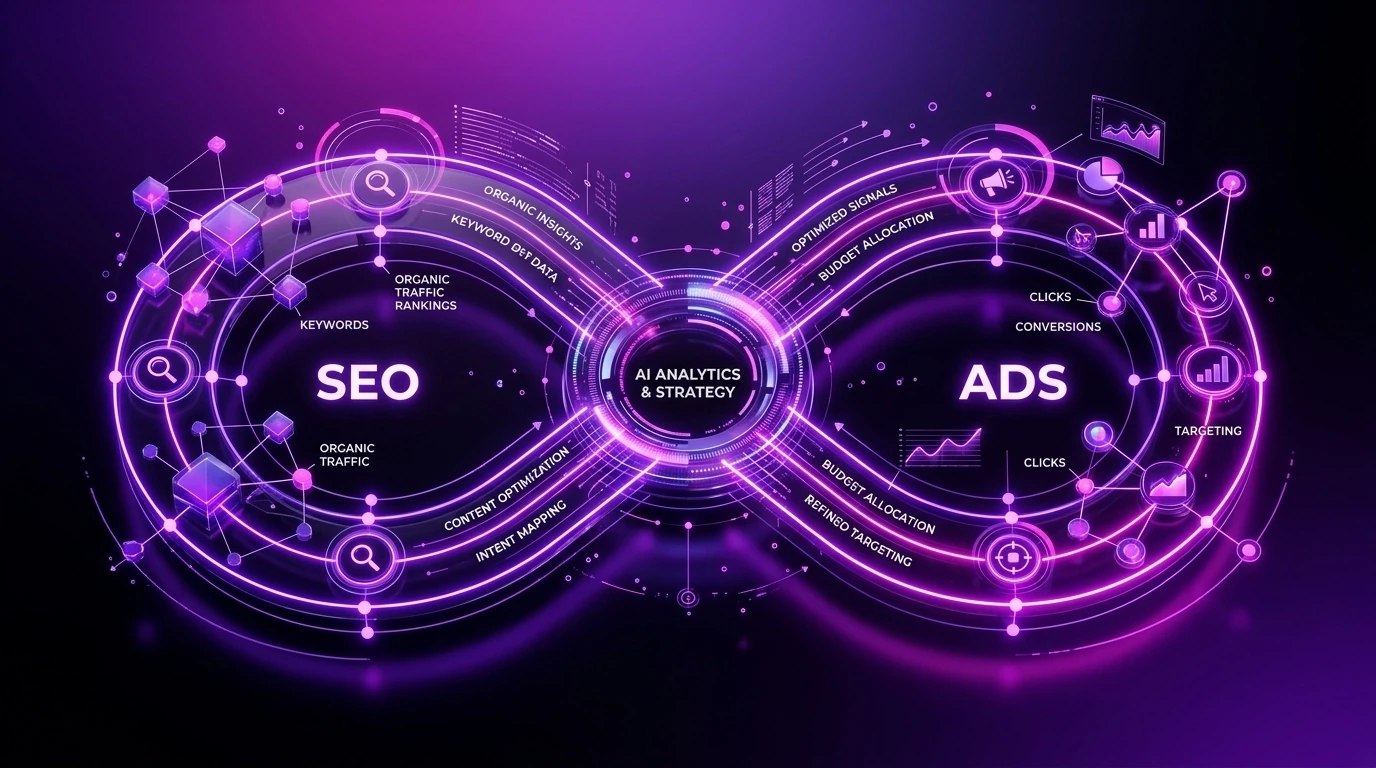
Think of it like this: Google Ads is your fast-moving scout. SEO is your long-term land grab. When they share maps, you win more territory.
Strategic Anchor: The strongest search strategy is not paid versus organic. It is paid plus organic, sharing intelligence like one coordinated system.
The Strategic Anchor: Stop Renting Activity. Start Building a Lead Engine
Managing Google Ads in Naples is not about “being visible.” Plenty of businesses are visible while losing money.
The real goal is to build a system that turns intent into revenue with as little waste as possible.
That requires:
smarter targeting
sharper positioning
better landing pages
faster websites
deeper tracking
honest reporting
real channel coordination
senior oversight
technical precision
accountability you can actually inspect
If your current agency is giving you generic strategy in a premium market, hiding behind vanity metrics, outsourcing the real work, or counting clicks like it’s still 2017, the issue is not your market.
It’s your setup.
At Nextus Digital Solutions, we fix the machine from the ad click to the close:
Google Ads management built around intent and ROI
high-performance Framer and Webflow pages that improve conversion economics
AI SEO that shares search intelligence with paid media
CRM and automation integration that tracks actual business outcomes
senior in-house execution with transparency you can inspect
You don’t need more activity. You need better architecture.
If you’re a Naples business owner, that’s the real test for any agency you hire: are they selling you motion, or are they building you machinery?
One burns budget.
The other builds enterprise value.
Ready to see where your budget is actually going?
We offer a deep-dive audit of your current Google Ads account, landing pages, tracking setup, and post-click funnel. No fluff. No mystery metrics. Just a direct breakdown of where money is leaking and how to stop it.
Book your Strategy Session with Nextus Digital Solutions today.